Thursday, December 26, 2013

Make the world a better place

2013 is almost over and all of us already have plans for 2014.

As an Indian, I would say that 2013 has had its ups and downs. We have had a lot of good news but unfortunately it has all been negated by a bunch of bad news along with it.

All around me, I see a lot of people who have lost hope. People who think 'Iss desh ka kuch nahi ho sakta!" And why just for the country? I know a lot of people who have given up on their dreams. Given up on the hope that there are good people in the world.

I have been called an eternal optimist by a lot of people. I don't know if they are being sarcastic or are complimenting me but because I am an optimist, I take it as a compliment. :P

I believe that there are a LOT of good people in the world and that all of us have the power to be good.

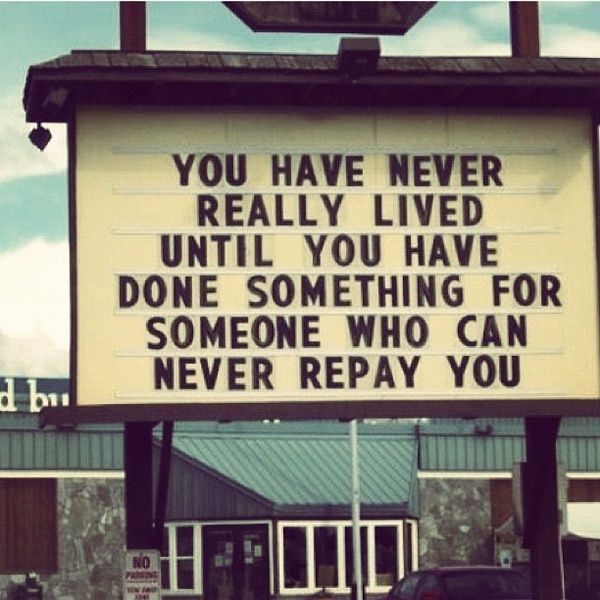
You don't need money or time to be good to someone. You don't even need a reason. I have realized the power of random acts of kindness.

It might seem too small and sometimes too random but it works like magic. I have seen it change people and I think that is the only way to cheer up a nation that is losing hope.

Imagine your mother is walking home from the grocery store and she has too many bags to carry. A kid from your society helps her carry those bags home. It just took the kid 5 minutes and no real effort but for your mother it will be a reason to smile for atleast a day. She will believe in good.

I love people who are kind and helpful. I don't mean just to their friends which although is important is not thing I am talking about here. I like it when strangers help older people navigate the escalator or when someone holds the lift door for someone or when someone sacrifices something small for someone else they don't know.

Small gestures go a long way.


I was fortunate enough to learn this when I am in my 20s. I have decided to do one good thing for a stranger once a week. I started with once a month but I then thought it was too low a target.

I would urge everyone to do one random act of kindness every month in the beginning and then raise the target based on how comfortable you are with it. I am not saying you have to force yourself to do something nice. Just don't miss any opportunity to do something good. It is more than enough.

If you want ideas about things you can do, leave a comment and I'll suggest something. :)

Merry Christmas and I hope you all have a fantastic 2014. :)

Best,

A


Thursday, October 10, 2013

Sachin


The dreaded day is finally here.

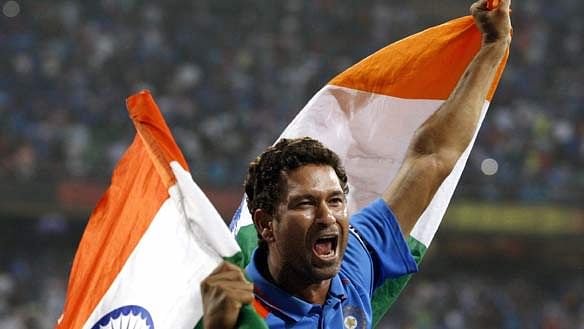
My childhood hero. The reason I started watching cricket. Sachin Ramesh Tendulkar retires from all forms of cricket.

God retires.

He taught an entire nation how to dream. He taught us how to believe that anything can be possible. He gave the nation hope.

I will not repeat the staggering list of records that he holds because for me, they do not matter as much as the fact that whenever he came out to bat, I felt proud to be an Indian.

Sachin is, for me, India's best sportsperson. He is the best ambassador of the game. He showed a young nation how being honest, hardworking and humble in any field can propel you to greatness. He showed the world that age is just a number when he made his debut at 16 and then again when he became the first person to score a double century in a 50 over match.

His child like enthusiasm is contagious. His dedication to the game and ability to adapt has ensured that he has stayed and thrived at the game even after more than two decades. He respects his opponents and has earned the respect of all his opponents.

He was the baby face assassin. Opponent teams used to be on their toes till Sachin got out because they knew, just like the Indian audience, that till Sachin is there on the field, anything is possible.

It was sometimes surprising how a person could carry the expectation of a billion people on his shoulders and still look so calm and composed on the field.

He has been asked to retire a lot of times. Forced out of the team. And what did he do? He came back! The Juggernaut rolled on. He has never been too vocal about anything. He, as Ravi Shashri would say, lets his bat do the talking. He has achieved almost everything that a cricketer could have achieved. Still, he has faced a lot of criticism. One of the them was India not winning when Sachin scored runs. I find that one the most demeaning for the great man. I mean, if he scores more than half the runs required at less than a run a ball and the rest of the team cannot even finish the game then how is it Sachin's fault?

For me, Sachin was the hero that India needed but not the one that it deserved.

Cricket will not be the same. Indian cricket team will not be the same. I don't think I can watch cricket anymore. If I do, I don't think I will ever forget the feeling of anticipation and expectation that I had every time Sachin came out to bat.

Sachin, for all you have done for the country and for us, THANK YOU!

Good bye Little Master. You will be missed.

- A Fan


P.S. - This is definitely not my best work. I am somehow unable to write. 

Sunday, September 8, 2013

Manmohan Singh should revolt.

Warning: This article is not a well researched, well thought out post that you will read. It is just one of the crazy ideas that came to my mind today morning.


Manmohan Singh is one guy whom the entire country has seen but only a few have seen him speak. Also, almost everyone agrees that whatever he speaks has been approved/allowed by Sonia Gandhi. It is a very sorry state of affairs when a country's prime minister tweets from his official account that he would be happy to work under someone else after the next elections.


It hurts even more when the person in question is the man who played a very important role in reforming a few sectors in India in 1991. It is still regarded as the day India got economic independence for the first time.

Manmohan Singh was held in very high regard and to see him go from there to a level where people of the country joke about his competency is really sad.

Now, what he can he do to earn back the respect that he commanded?

Step 1 - Leave Congress. Join a party which he thinks can form a government.
Step 2 - Tell the country why he went from being a free market economist to a socialist.
Step 3 - Tell the country about his working relationship with Sonia Gandhi and Rahul Gandhi in detail.
Step 4 - Tell the country what he really thinks about the schemes that the Congress government has passed.
Step 5 - Orchestrate the change in government in the 2014 elections.
Step 6 - Try to convince the new government to make him the Finance Minister or something similar.
Step 7 - Bring the country back on the right track.
Step 8 - Smile and talk.

If he does this, it will have positive effects on a lot of things/people:

1. People's faith in him.
2. People's faith in politicians in general.
3. Country's economy.
4. Parties opposing Congress.
5. Tax payers who are frustrated to see their money being wasted on money-draining schemes.
6. Other politicians who are acting as puppets will be inspired to revolt.

I realise that this is something that has almost no chance of happening but just imagine the consequences on the Indian political system if its does.


Tuesday, August 13, 2013

Taxes and Subsidies : A vicious circle.


When I was a child, I had often wondered, why do we have taxes?

I mean, my mother and father went to work all day and earned their salary in an honest way. Why should they give the government a large chunk of their earnings?

One day, my doubts were cleared by an elderly gentleman who had the patience and the time to do so. He told me that we payed the government so that we have roads, electricity, water and other such resources. He said we paid taxes so that the government can give food to the poor people at a cheaper rate so that they could also fill their stomach.

As a child, I was unconvinced. I did not know why but the explanation just did not set with me.

When I grew up, I realised that tax money was used by government in giving subsidies to the poor as well as providing everyone with basic amenities.

So, government took money from parents. Decided on what schemes to use that money on. Used the money for people who needed it. Problem solved!

So, to simplify it, government did charity on my behalf.

Now, what I don't understand is, why do we need the government to do this?

I mean, if I really want to or have to help someone, why can I not decide whom to help and how to help them?

I do not agree that just because some people are rich, they have a duty to take care of everyone that is poor. I believe that everyone should get what they deserve for their work. Please read my post on The Robin Hood Concept for more details on this.

In the current scenario, the government is spending a lot of money in collecting taxes. After that a lot of money is lost on schemes which have good intentions but are implemented poorly. Not to forget the major share of corruption in 'redistributing' the money.

So, I have to pay only Rs 400 for a job to my maid because she is supposedly getting benefits from the government and so can manage on a meager salary. I have to give 30% of my income to the government so that it can provide these benefits to my maid.

Unfortunately, all the money that I give to the government, hoping that it would reach my maid, does not reach her. Some is lost in administrative expense. Some is lost in mismanagement and the lot of it goes to corrupt 'distributors'!

Instead, why can't I just pay my maid more and pay less taxes?

In this way, I will be paying my maid exactly what she deserves based on the price decided by market forces. The government will not have to collect money from me and give it to my maid. And my maid will get what she is entitled to for her work. Doesn't it simplify the entire process?

It not only makes it more efficient but also a lot more reliable. Plus, because I get to choose where my erstwhile tax money is being used, I cannot complain that the government is wasting my tax money.

Ofcourse this cannot be done overnight. The reduction in taxes and subsidies has to be simultaneous.

The only way to reduce corruption is to improve the moral fabric of the society but till then we must work on reducing the number of opportunities where people can be corrupt.

If we increase the subsidies, more and more people would want to be in the group which is entitled to these subsidies thus defeating the entire purpose of it.

Let us focus on creating wealth before we start redistributing it. 

Tuesday, July 16, 2013

Our classroom in Mumbai.

Hello,

I am Apoorv. I am a Teach for India teacher. I teach in a school where kids from low income families come to study. I am writing this blog to raise funds for my kids.

Who are my kids?

They are 49 students of 7th standard in Divine Child High School in Malad (East), Mumbai. They are the most amazing bunch of students I have ever met in my life. They are inquisitive, joyful, eager and have an unquenchable thirst for knowledge. They come from families who are completely invested in wanting to improve their child's life. They are kids who have achieved a lot over the past few years but are still just warming up. They are kids who don't get confused when they see a new word. They find out its meaning and then try to use it in day to day conversations. They are kids who can ask you uncomfortable questions about your field of expertise.They are kids who are can surprise you with their answers and their level of critical thinking. They are kids who know that understanding everything is more important than just remembering it. They are kids who work harder and smarter than most kids their age and they do it under trying circumstances.They are kids who are always ready for a challenge. They are my kids.

But we need your help.

There are various ways in which you can help us:

  • Volunteer: Come teach the class. Give the students a different perspective about a topic of your choice. They have not had a lot of exposure with the latest happenings around the world so getting to know more people would be wonderful for them.
  • Send us books! : If you have old books which are in good condition then we would love to have them as well. You could buy new books and send them to me. You can choose any book which you think a school going kid should read. :)
  • Sponsor our field trips : There are SO many places in and around Mumbai which my kids haven't seen yet. We do not have the resources to take them around in a bus. If you fund one of our trips, we promise to send you photos. :)
  • Scholarship for the students: Our's is a private school and so the kids do have to pay fees. Our monthly fee is Rs 550/- and apart from that we also have a lot of other misc expenses which add up to a lot. A lot of my kids struggle with the fee payment. Scholarships are a great motivator and have proven to work amazingly well for students. 
  • Buy us stuff : We have a perpetual need for stationary. We need a projector and preferably a small screen too. We need board games and a few sports equipment.  
This is just a suggested list. If there is anything else that you would want to do for the students then please feel free to contact me.

How to contribute?

If you wish to contribute in any of the above mentioned ways please send me an email on apoorv.shah2013[at] teachforindia.org or call me on +91 9925027956 any time after 2pm. You can also leave your contact details as comments on this blog and I will get back to you in a day. 

You can wire transfer the money or send us a cheque. More details will be given when you send me the email. :)

If you want, you can go to this link on the Teach for India website and choose me 'Apoorv' in the "donate to specific fellow" tab. Here's the link: http://www.teachforindia.org/donate/give-instantly 

All your contributions will be judiciously used. Highest level of accountability and transparency will be maintained. We will see to it that your contribution is optimally utilized. 

If you have any queries, please direct them the email id. 

You can also get regular updates about the happenings in class on my twitter handle @apoorv3E

Now to end with some amazing news.

I had posted on my facebook account about a similar request and was overwhelmed when I got 5 people willing to sponsor the students. I received scholarship money from one of the donors a couple of days back and received a book from another today.

Here's the photo of the book. 


Me and my students hope that this is just the beginning. :)

If you are in the area, please do come visit. :) 

Thanks

A

Update: I received 3 more books and close to 10,000 Rs in scholarship donation money after this post. Thank you to everyone. We have made a good start but there is a long way to go. :) 

Monday, December 3, 2012

BRST: A dream turning into a nightmare


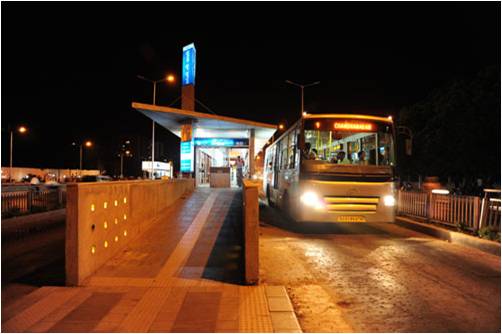
If you have ever visited Ahmedabad you are very likely to know about BRTS (Bus Rapid Transit System). Its not the first of its kind in the country but it is arguably the only one that still functions properly. It was started to reduce the traffic on the roads. Ahmedabad did not have a good public transport system apart from the city buses. BRTS was envisaged to be a cheap and fast way of transport in the city.

BRTS Ahmedabad has won a lot of national and international awards. It has been successful in reducing pollution by reducing the number of vehicles on the street. Ahmedabad has a population of over 70 lakh and BRTS is the first step in creating a good public transport system.

I traveled on the BRTS bus in the very first week it started. They were amazing. Comfortable seats, cheap tickets, well thought out route and courteous staff. It felt like the city was finally moving in the right direction with regard to traffic management. A lot of people started using the BRTS instead of their personal vehicles. I started using it instead of using an auto rickshaw.

Everything seemed to be working well until BRTS became a victim of its own popularity. It is estimated that more than 60 thousand people travel in the BRTS everyday! That's a lot of traffic for what is, as of now, a limited fleet of buses.

The problems with BRTS right now are:

  • The buses which ply on the route are already started breaking down. I am not sure if its because of the way they are used or because of the quality of the buses from the beginning. Seats have started breaking and the automatic doors don't work properly. 
  • BRTS drivers drive very rashly. The number of accidents that occur on the route every month is a sign of it. I mean, how hard is it to drive a bus in a dedicated lane on the road? 
  • The ticketing system is manual which means that there is a railway station like que at every BRTS station. If you really want to save time and make it convenient for the passengers then I guess automatic ticketing counters, like they have in some of the foreign countries is the way to go. Smart cards have recently been introduced but by and large most people still use the normal ticketing system. It is a waste of time and precious resources. 
  • There is no limit on the number of passengers in one bus. So during peak hours, all the buses are filled way beyond capacity. Its almost like a Mumbai local train. This happens because the number of buses are less compared to the number of passengers. 
So, what can be done?
  • Proper training should be given to drivers so that accidents do not occur on the route. They should be held accountable for the accidents that occur due to their error. They should be asked to not speed needlessly and brake suddenly. It causes passengers to fall over one another and injure themselves. 
  • Increase the number of buses and limit the number of people in a bus. It is my rough estimate that the bus has 50-60 seats. Close to 30 people can easily stand in the bus. So, if we limit the number of people in a bus to 100, it would mean that everyone in the bus would be comfortable. I know that it means a lot of people will have to wait for another bus just because the bus that has come has no capacity but I guess we have to do it so that the life of the buses and the roads and the travelling experience of the passengers is improved. An increase in the number of buses will be a big financial investment but if the journey is made more comfortable, a lot more people would take the BRTS than riding their personal vehicle. 
  • Smart cards should be encouraged. They save a lot of man hours and are also very convenient. A small discount on recharge of smart cards could be one of the options.
These are some of the small things which can go a long way in improving the BRTS experience. I traveled in a choc-a-bloc BRTS bus yesterday and heard a lot of people complain about the quality of the service. They said that this was the last time they were using BRTS. I would also not take it willingly if the situation does not improve. 

Also, I should add that people in the city do not have the simple courtesy to stand in a line to get into the bus. Whenever a bus comes to the stop everyone starts acting like the world is ending and the bus is the only place which is safe. Also, I will never understand the obsession that some people have with standing right in front of the door when their stop is 30 minutes away. Not to forget the die hard romantics who think it is mandatory to write their lovers name in all public places. Sadly, public transport in India doesn't mean it belong to everyone, it means it belong to no one. Its the people's mentality towards public assets that hurts the development of the country.
 
Coming back to the point, a public transport system should be something that the people of the city are proud of. This will make it more effective and help it serve its purpose. If I know that BRTS is a comfortable and efficient way to travel across the city, I will ask others to use it. The entire purpose of a public transport is defeated if the public which is meant to use it, does not think it works well. 

If the government does not do anything to improve the BRTS, this dream will definitely turn into a nightmare. 

A

Saturday, June 16, 2012

Romanticizing The Rain


I got drenched in the first rains of the season today. I usually do that. Although I am someone who never really liked rain. Rain was the annoying thing that came in between the smell of wet sand and cool breeze. I was told by someone that EVERYONE likes rains. It was supposed to have that romantic feel to it. Well, I had never felt it. For me, it was just rain. 

Until today. Today I felt kind of liberated by the rain. I felt like sitting still in a place and just letting the rain fall on me. I wanted to experience it and I did it. The rain washed away the dirt marks on my bike but along with it, it also took away the negativity that had been building up inside me. It was like a release from all inhibitions. 

After a while, I wanted to drive around the city. I wanted to watch people enjoy themselves in the rain. Watching people act in a carefree way and being happy, made me happy. A friend pointed out in the afternoon how everything looks clean and serene after it rains. Rains had calmed me down. 

After I reached home, I sat near the window and saw the rain trickle down the window. I saw it in the street light. I saw it in the lights of passing vehicles. I saw it in the moon light. I was fascinated. I put my hand out of the window and just sat there as raindrops kept bouncing over the palm of my hand. 

I now understand why people find rain romantic. It is not the boyfriend/girlfriend or husband/wife romantic. It seemed more platonic. I am not sure how to explain it but I am sure about one thing, it felt nice.


I've had my share of dancing in the rain for this season but I am sure that my new found love for rains will continue to grow. If you are someone who doesn't like rain then I would recommend that for once, instead of just playing in it or running to find cover, stand in an open area and experience it. It might change you. 

:) 

P.S. : The only thing that disappointed me was that there was no one around me who was nearly as hot as Kareena Kapoor or Katrina Kaif or Raveena Tandon. :P


Sunday, June 10, 2012

Satyamev Jayate

Satyameva Jayate, which literally translates to 'Truth Stands Invincible' but is popularly known as 'Truth Alone Triumphs'


In the past month and a half, it has gone on from being a phrase on the National Emblem to the name of a 'revolutionary' television show hosted by the actor/social activist Aamir Khan. The show deals with one social issue in every episode. It has dealt with Female Feticide, Child Sex Abuse, Dowry, Unethical Doctors, Inter Caste Marriages and Disability. 

The show is being touted as being 'revolutionary'. It is said to have made the 'idiot box' intelligent and smart. People wake up early (11am) just to watch this show!  Well, sorry to burst your social activist bubble but some of the presumptions you have about the show are just myths. 

Myth 1:  The show reaches out to everyone and unifies Indians against one social evil every Sunday. 

In India, television penetration is less than 25%. It means more than 750 million people in India have never seen Satyamev Jayate. So claiming that it is unifying India against a social evil is not correct. It is infact not reaching out to EVERYONE. To compare it with other shows, a newspaper article stated that Kaun Banega Crorepati's all seasons had higher average viewership than any episode of Satyamev Jayate. Yes, even the season that SRK hosted. Tarak Mehta Ka Ulta Chasma is almost as famous as Satyamev Jayate.

Myth 2: It's not just the show, its the discussions that take place at everyone's house after the show that are the real contribution of the show. 

Discussions don't take place in all homes. It is only a marginal number of homes in which meaningful discussions take place. Also, the homes in which discussions are taking place are the homes which would not follow any of the social evils even if the show was not aired! Discussions would have been fruitful if they happened in a home where change was required. A 'modern' home, where all family members follow social norms and are, to a greater extent, ethical, will not really benefit from just a discussion. 

Myth 3:  Satyamev Jataye is not biased towards any side and give a complete picture of the situation. 

The show takes a side. I am not sure why a show which is discussing real problems in the society needs to be a monologue. Why not give the other party a chance to explain their side of the story? Ofcourse, people who ask for dowry and kill unborn children are never going to defend their actions but what about doctors and offices which apparently 'discriminate' against disabled people?  I am sure they have a logical and reasonable argument for all the accusations that are made against them on the show. Bring them in. Make it a meaningful discussion and not a sob fest. In a few episodes, there have been grave factual errors. Statistics are often interpreted in such a way that they support their cause.

Myth 4: Aamir Khan/ Satyamev Jayate were instrumental in the getting the The Protection of Children from Sexual Offences Act, 2012 passed in the parliament. 

If you really believe an episode on television is all it takes to push the parliament to pass a legislation then you are mistaken. Social activists do make a significant contribution to some legislations but Satyamev Jataye had nothing to do with the passing of this Bill. I have been told that a few NGOs had been demanding for this legislation to be passed for more than 5-6 years now. They are the ones who should get the credit for it. Their work in the field is substantial and has been going on for a long time.

Myth 5: Aamir Khan is the Anna Hazare that works. 

Aamir Khan has been involved in many social issues over the years. Be it the rehabilitation for people affected by Narmada Canal or Gujarat Riots or Farmer suicides. I was really happy when I saw that a 'Star' was making good use of his power. I was disappointed when I later realised that his interest in the first two issues diminished once Fanna released and in the third issue once Peepli Live released. My respect for him was revived when he went to support Anna Hazare but instead of shouting anti-government slogans, he urged people to stand for elections and vote for the right people. Alas, it was just a one off incident. 

I am often accused of being anti Aamir and I don't disagree. I don't like him and this might be reflected in the post. I have tried to give reasons for most of the things stated so as to convince you that I don't dislike the show because I don't like Aamir. I think the show is given more credit then it deserves. Just like Aamir Khan. I would have loved it if Aamir would have encouraged people to participate in the democracy and improve the system from within instead of fighting it. Awareness is important but implementing laws is an altogether different ball game. People now watch an episode and send a SMS to a ridiculous question at the end of it and they feel that their work towards the society is done. If Aamir Khan has the power and the conviction to bring about change in the people and the society and if he has the support of a lot of people, why no contest elections or even support a candidate whom best represents his views? For eg in Hollywood, look at Arnold. 

Preparing a script and making a show is easy. Everyone can whine. It's working to solve the problems that separate the men from the boys (or the women from the girls). Working on these issues in real life is difficult. There are a lot of organisations out there who are working tireless to solve problems. They do not get enough credit for their work. They are the unsung heroes of the country. 

P.S. : I am, in no way suggesting that Satyamev Jayate has done nothing good. I am also not saying that it is not working for the society. I am just saying that for the amount of attention and praise it is getting, it is not doing that big a job. There is scope for a lot of improvement.

P.P.S. : For all those who tweet about Satyamev Jayate, #SMJ is incorrect. It's Satyam Eva Jayate and not Satya Meva Jayate. 

Jai Hind! 


Tuesday, May 22, 2012

Alexis's Graduation Speech in Castle S04E23

This is the graduation speech delivered by Alexis, Castle's daughter from the popular series Castle. It is shown at the end of Episode 23 of Season 4. I loved it so decided to share. 


________________________________

There is a universal truth we all have to face whether we want to or not. Everything eventually ends. As much as I’ve looked forward to this day, I’ve always disliked endings. The last day of summer, the final chapter of a great book, parting ways with a close friend. But endings are inevitable. Leaves fall, we close the book, you say goodbye. Today is one of those days for us. Today we say goodbye to everything that was familiar everything that was comfortable. We’re moving on. But just because we are leaving, and that hurts, there are some people who are so much a part of us they’ll be with us no matter what. They are our solid ground, our north star. And the small clear voices in our hearts that will be with us. Always.
Alexis Castle


Tuesday, April 24, 2012

Medical students going to USA have to promise to return


In one of the most inexplicable moves ever made by the Union Health Minister, Indians who want to go to USA for higher medical studies will have to sign a bond with the Ministry of Health and honour the document by returning home after finishing their courses. 

USA has, for reasons that I don't know of right now, made it mandatory for students to get a NOC (No Objection Certificate) from the Government to enroll in an American Institute. I'll update the blog when I find out the reason. 

Government says that if the students don't come back then they will write to the American government and bar that person from getting a license to practice there. Also it is not clear for how many years the government wants to students to stay in India after they force them back post studies. This apparently is going to stop Brain Drain. 

First of all I don't believe that brain drain is a problem. India has become such a power to reckon with because of the impression that Indians have created and the work Indians have done in foreign countries. It is how we have created out soft power. Also, Indians send a lot of money home. It's almost enviable. There are so many villages in India which have developed only because of the money their erstwhile residents have sent from their foreign locations. 

AIIMS has come out with a stat that is costs around 1.7 crore to produce a single MBBS student. It includes all the expenses and subsidies that the government spends on them. So this move is to apparently get all that money back through taxes. 

India has one doctor for every 1700 citizens. This ratio is very low compared to a lot of other countries. A recent Planning Commission report said that India is short of 6 lakh doctors, 10 lakh nurses and 2 lakh dental surgeons. I agree that India needs medical professionals but that does not mean you put reins on anyone and everyone you can get your hands on. 

If its just a matter of getting back subsidies so that they can be used to benefit others, then I have a solution to it. Remove the subsidies. Make everyone pay full amount. If the student works in a government hospital (urban or rural) for 10 years, then reimburse the fees. Although the government will have to improve the accountability system in government hospitals for this to be meaningful. 

A relatively easier solution is to allow and incentivise private universities to come up. Stop holding on to the 'noble profession' tag. Private individuals will not be ready to invest if there is no profit motive. If the government can't do its work properly then it should atleast let the private sector give it a try. Checking the quality of teaching in private institutions will be a cause of worry but then government colleges are not in very good shape themselves. 

The government declared the National Rural Health Mission without thinking about where they will get the manpower from and now they are looking for slaves. Disgusting. 

Dear Government,
You are not supposed to control. You are supposed to regulate. Stop coming up with random schemes and messing with development which is going on inspite of you rather than because of you. 
Sincerely,
Frustrated Student


Update: Read - Swaminomics: The Fundamental Right to Migrate 

Saturday, April 7, 2012

Right to Education: Reservation in Private Unaided Schools


The Right to Education (RTE) Act of 2009 is being portrayed as a landmark legislation in the history of the country. I had the privilege of interning with the Principal Secretary of Education for Gujarat. It was around this time that the office was working on Rules to implement RTE in Gujarat. I got the chance to read those Rules before they were actually published for the whole world to see. 

I dislike quite a few things about the RTE Act. Although one such stipulations takes the cake. It is according to me, the most damaging provision in the Act. 

From June 2012, every primary school in Gujarat will have to compulsorily admit 25% students who are from “economically and socially backward” strata of the society. By every primary school, they actually mean ALL of them. Yes, even the private schools which don't take any grant from the government. This will, according to the government, integrate poor students into the main stream. Nobel thought but bad implementation.

The Government will pay fees for these 25% kids. The schools will be reimbursed by the government to the extent of the expenditure incurred by a child in the government school. It means, if the government's per student expenditure per year is Rs 5000/- but the private schools fee is Rs 20,000/- per year, the private school will be paid only Rs 5000/- by the government. Consequently, private schools will recover the difference amount from the remaining 75% of the students! 

Consequently, everyone will try to widen the definition of "economically and socially backward" strata just to abuse the economic benefits attached to it. For, the policy that is “pro-poor” will, like all policies which are “pro-” something; increases that something.

Also, due to the shortage of quality schools in the country, a lot of corporate are opening up schools by themselves. They want to enter into the education sector for the long run. It is both, a service to the society and a money spinner. But with reservations being brought in like this, corporate will be discouraged to enter. Considering India’s need for schools, the government will in no way be able to start and manage the requisite number. Government needs private schools to flourish. In the Education sector, like in any other sector, setting the market free is the key to development.

Instead of trying to bridge the economic divide, government should try and reduce the hurdles which come in the way of setting up new schools. Reduction in red tape, loans and encouragement are the only things required. Government does not need to manage the education sector. It just needs to regulate it.

Education is one sector that was left behind in the 1991 reforms. We have delayed it long enough. The time; is now.

P.S. - For all Acts, Rules, Amendments, Bills, Notifications and Guidelines on the RTE, check this 


Thursday, April 5, 2012

How Mediation can benefit the Business Community


Businesses cannot always avoid disputes. They are bound to occur. The Chinese character for conflict ‘冲突’ means both "danger" and "opportunity". There are a lot of ways in which these disputes can be resolved. Litigation is the one that most businesses choose. It is not because it is the most effective, which it is not. It is because that’s the one everyone knows about. Only a few people know about how effective Mediation can be in solving disputes. When a dispute becomes a lawsuit, the parties become adversaries and relationships are destroyed. Mediation helps to preserve ongoing relationships.

Mediation is based on the premise and on the value system which says that parties to a dispute are the ones most capable of resolving that dispute, and that the parties themselves should play the central role in any efforts to work through their own conflicts.

Business Community has a lot to deal with already. Lengthy procedures and wastage of time on petty disputes take away focus from the main objective of the business. Mediation is less disruptive to the business. It requires less preparation time and so less time away from the business than when litigating in court. Time saved from non-business activities creates more time to further the business objectives.

The advantages to the business community in using Mediation as a dispute resolution method are:

  • The first and the most important is definitely the fact that the parties can control the process of dispute resolution. They can make ground rules. This gives them the flexibility to work more comfortably in solving the dispute.
  • Mediation lets the parties control the outcome of the dispute. If you go to court or arbitration, you are leaving the decision to a judge or an arbitrator. The result might be the right decision in law but may not be the best one for your business.
  • Cost of mediation is quite low compared to that of litigation. Lawyers are not compulsorily required and there are no compulsory rules of procedure which have to be complied with by the parties to the dispute. It is a major factor when one or both the parties are relatively cash strapped.
  • Mediating a dispute will allow the parties to deal with real issues. So instead of legal issues, more personal issues can be discussed.
  • It also allows parties to discuss technical issues at length. It might not be possible in a court room considering the shortage of time and lack of expertise of a judge.
  • A business needs to be fast and efficient. A dispute resolution which is also fast and efficient should be chosen. Mediation takes lesser time than litigation and has an higher chance of being successful.
  • One of the major factors that businessmen worry about is confidential information being discussed in open court. Mediation takes care of these confidentiality issues. It’s a private process where only a few members of both sides find out about things. Anything discussed in mediation cannot be used outside because all parties sign a non disclosure agreement. Thus, confidentiality is ensured.
  • Mediation sees to it that relationships are not affected in trying to solve disputes. It is very important for businessmen to see to it that they are on good terms with everyone. No one would like their business to suffer because of some past dispute. Disputes are short lived, businesses go on forever.
  • Parties don’t need to just solve their dispute. They also need to plan for the future. Mediation can sometimes build relationships which can turn out to be fruitful for the future. This is because, during mediation, the discussions are not restricted to just the present but also include the future.


These are just some of the benefits. The list is not exhaustive. Actual benefits may be more and are subjective. The benefit of Mediation over negotiation is that in negotiation, only both the parties are present and there is no one to moderate the discussion. This sometimes leads to acts like shouting, name calling and threatening which jeopardise the dispute resolution.

Mediation process generally has a third party mediator who is not inclined to support any of the parties. His main objective is to see to it that the dispute is resolved in the best way possible. The mediator does not obey to any of the parties, and is a third party, looking at the contraposition from an objective point of view.

Mediation works wonderfully well in real business problems. For example, it can help solve consumer disputes. If the company feels that the consumer’s problem is genuine then they can solve the dispute then and there.

Mediation can also be used to solve contract disputes, service matters and even labour problems. The fact that Mediation can be used in so many different spheres and that too with such high efficiency is amazing. Creative ways of resolving conflict by owners and managers can add to the bottom line of any business whether large or small. Disputes, however small and unimportant, distract and drain the businessman.

Mediation sees to it that all disputes are solved through a collaborative approach so that both the parties are happy and the relationship between them is not strained. Mediation is the first thing that should be tried when there is a dispute. If it fails, you can always go back to litigation and arbitration. The availability of a back up is also one of the big reasons why Mediation should be given a chance at all disputes.

The advantages for businesses in adopting mediation processes, either through outside contracts or internal programs, are multifaceted and immeasurable.

The courts of this country should not be the places where resolution of disputes begins. They should be the places where the disputes end after alternative methods of resolving disputes have been considered and tried.”- Justice Sandra Day O’Connor

Tuesday, March 6, 2012

Dear Law School Administration

Dear Law School Administration,

There are two types of students that you can meet in life, law students and others. Please be very afraid of the first kind as they are the sharpest, meanest and the most bored form of student that you will ever have to face. 

Why you ask? 

Well, here are a few reasons:
  1. Smallest of problems will be held as 'violating our fundamental Right to Life'. The bathrooms are far away and sometimes don't have water? Fudge you, that's my fundamental right you are violating. 
  2. Everything that is done by you without absolute transparency is arbitrary. You choose a room on the third floor as your cabin when all other related offices are on the first floor? That's totally arbitrary.
  3. If the students don't like it, it is probably unreasonable. 
  4. We are looking for a fight. Give us the slightest opportunity and we will come charging towards you like a bull comes towards a matador with a red flag. 
  5. We will threaten to file a PIL for everything. You threw out my favorite guard? See you in court!
  6. Quoting case laws during all conversation comes naturally to us. It's our bread and butter. So if you don't understand them then don't give us the O.o look. 
  7. Most of us have a better command over the English language than other non-law students. Maybe its because we are used to drafting stuff or because we read a lot of books. We can write simple stuff in a complex way and also simplify complex stuff. Email and Facebook comment wars are one of our hobbies. 
  8. We are not just argumentative. We are bloody good at it. It is not a surprise considering how much practice we get. We can argue about *everything* from Messi to Madonna to Mulayam Singh Yadav to Mumbai Indians.
  9. Reaching a consensus is not a possibility. Atleast not for the first 5 hours of the discussion. So next time you ask for our opinion, take out sufficient time. 
  10. It might seem like we don't pay attention in class but we magically remember all the lessons from class when we need to use them in arguments with faculties. "Sir, you only taught us arbitrariness and abuse of dominant position."
  11. Didn't give me an opportunity to justify myself when you caught me using my cell phone in class? Well, you can't punish me. You violated principles of natural justice by not giving me a chance. Lawyered!
  12. Precedent is effectively used. If you did or did not do something about an incident some years ago, we will hold you to it and make sure you do it in the exact same way. Unless ofcourse we are benefiting from the change!
  13. "You don't have the authority to do this." Yes, this is one of our favorite lines. 
  14. We possess the amazing ability to argue both for and against a fact. 
  15. If everything else fails, we will always have humanitarian grounds as our backup option. 
So, if you think you can mess with us and get away with it? All we have to say is: 


P.S. - All law school administrators who are reading this, this is not a threat or something. No intention to offend anyone. These are just a few points law school administrators need to take care while managing students with this specific skill set. If you still find it offensive then well, there's nothing much you can do about it. :P


Wednesday, December 14, 2011

Subsidies are injurious to health


Contrary to popular opinion, subsidies do more harm than good.

This is even more true in a country like India where corruption is commonplace and inefficiency is a major problem in the government. Our government gives subsidies for all the wrong reasons. These subsidies do everything other than helping the target group. I should make it clear that by subsidies I don't mean just monetary let offs. I also mean 'welfare' schemes of the government. Giving free housing, loan waivers, subsidized electricity and reservations in educational institutes is all a part of subsidies. 

The government is so busy trying to redistribute income that it has almost forgotten about generating income in the first place. 

Take NREGA for example. It is called a 'You dig, I fill' scheme. The government pays people to dig up an area and then pays a few other people to fill it up. This is their way of giving away money while showing that they are working towards improving rural infrastructure. 

The problem is, this is all manual labour. They don't teach skills. Workers who get 100 days of employment are still sitting idle for the rest of the 200 days. There is no improvement in their ability. These people get jobs because they are entitled to a job and not because they deserve a job. 

The point being, if government gave training instead of subsidies, it would be much more useful to these people. We all know that its better to teach a man fishing than giving him a fish. Leave the creating jobs part to the private sector. If the government can make the unemployed people employable then that will be a big feat in itself. 

The world thinks that India has cheap labour. You can get people to do household chores and stuff for a fraction of a price that you have had to pay in foreign countries. This is infact a myth. Our labour class is almost as expensive as any other country. It's just that we pay for it in two ways. First, we pay them their salary which is direct income for them and then we pay taxes which are used to literally give away money to these people. So in the end, government is just a middleman. A middleman who has a huge opportunity to be corrupt and who has used this opportunity to its full extent. The problem is not expensive labour. The problem is that, due to this government interference, citizens have to pay more taxes but the money doesn't reach the labour class. Hence, both sides are unhappy and this leads to a problem of high taxes and poverty at the same time. 

So why not remove subsidies all together?

Let the citizens pay a high price for labour but reduce their tax burden. This way, the labour class can lead a better life and money can be effectively utilised. Ofcourse, corruption goes down as well. It's a win win situation. 

Unfortunately, the corrupt government workers are the only ones that don't win. Politians won't be able to use it as a 'vote gathering' activity. People responsible for distributing these subsidies won't be able to get their share. 

So, the next time you hear about a subsidy being dolled out, remember the fact that its your money they are giving away. You are going to pay for it in one way or another. Don't vote for the guy who gave the maximum number of subsidies. Vote for the guy who makes subsidies redundant. 

Cheers

Wednesday, November 30, 2011

What does 51% FDI in multi-brand retail mean?


What happened

Government has decided to allow 51% FDI in Multi-brand retails. 

What are the pre-conditions

  • Minimum investment of $100 million.
  • 50% of the investment is to be in backend infrastructure development.  
  • 30% of all raw material has be procured from small and medium industries. [Not completely sure]
  • Permission to set up malls only in cities with a minimum population of 10 lakh.
  • Government has the first right to procure material from the farmers.
  • Products should be sold under the same brand internationally.
  • Foreign investor should be the owner of the brand.
Present Condition:
  • Farmers get only 10 to 15% of the price we pay. 
  • 3-4 middlemen in between farmers and customers.
  • Huge post produce losses for farmers due to inadequate facilities.
  • A poorly managed food supply infrastructure.
Why do we need it:

  • We are the second highest producer of fruits and vegetables in the world but still we are not able to utilise is properly because of inadequate infrastructure facilities. 
  • It will reduce pre-harvest wastage/losses and thus help control food inflation. 
  • It will create 1.5 million more jobs in 5 years. Apart from the huge number of indirect employment. 
  • It will increase competition which is always beneficial for the customer.
  • It will remove the middleman from the equation. It will reduce costs which in turn will reduce prices. 
What about the problems:

There will be no problems.

We already have local players like Reliance Fresh and Big Bazaar. They have done wonderfully well. Local traders are still trading as they were. Why not allow foreign players? They will bring with them human/monetary/knowledge capital which are very important for a developing country like India. Just bringing proper storage places will go a long way in solving the wastage problem. 

China, Brazil, Argentina, Singapore, Chile, Thailand, Russia and Indonesia all allow 100% and their economies have benefited from this move. India is only allowing 51% and that too with a lot of checks. 

We don't have to worry about monopoly because the Competition Commission of India can handle all anti competitive practices including predatory pricing. 

In India, cities with population of more than 10 lakh are just 53 in number. This means that any negative impact will not have huge repercussions. Kirana store walas in majority of other cities cities will be totally unaffected. It's a small but steady step on the path of liberalization. 

It will decrease unorganized labour sector and bring them all under organised labour. This will it will be easier to enforce labour laws and also check its implementation. 

A lot of jobs will be created. Ofcourse a few will be lost as well but that number will not be very high. There will be a reorganization of the job structure rather than a reduction. 

It is true that the government can also provide all the infrastructure facilities that the companies will provide but  true governance means less government role and more freedom to the society. Why should it be a problem if companies improve infrastructure facilities in return of a gain? 

Thus we can see that the FDI rule is for the greater good of the society. Oppose it at your own risk. 


Tuesday, November 29, 2011

"I can't afford an internship." : A take on Unpaid Internships in India


Internships.

Arguably the most important part of a student's CV. 

Internships in India are hard to get in spite of there being so many law firms, companies, NGOs, LPOs and other such organisations. An internship at a 'reputed' place is like a star on the CV. If you have 5 or more stars then you either have a CGPA worth killing for or are an awesome jugaadu. 

Whatever be the reason, I can safely say that internships are very very important. Not just from the CV point of view. Also from the experience of the practical experience of a specific field. 

In India, majority of the internships are unpaid. 

So, students get: cut throat competition, shady PGs to stay in, work during vacations, time away from parents and home city, rigorous office hours and NO PAY. 

Organisations get: FREE labor, temporary clerks/secretaries and no responsibility. 

A majority of the students are not from the metros but most of the internship places are in metros. It means, students have to spend money on travelling to the city, accommodation, food, travelling to the office and other misc expenses. All this and what do we get in return? Experience? Knowledge? Chance to get coffee for the boss? Chance to pass around files? Old cases to read? 

Just because interns are not 'workers' and do not have a union of sorts, organisations feel that they can exploit them. Interns are not given enough importance. They are students who are facing a lot of difficulty and trying to learn and sustain themselves. The least organisations can do is dedicate an hour a day to actually teach them something and pay them something which can offset their expenses for that time duration. 

LegallyIndia pays its interns Rs. 10k/month. It is seen as a very 'handsome' amount. Considering what other organisations in India pay (or don't pay), yes but not quite handsome when you consider the expenses of staying in Bombay for a month. It just covers all expenses which in the present Indian scenario is a very big thing. 

I have heard interns being paid Rs. 2k for a 6 week internship in Delhi. Yea, 2k might just cover food expenses for that time. So effectively, the intern is spending money to do free work.

I can understand non-profits not paying their interns. Although its not completely alright, but its understandable. They have their own fund raising problems. But firms/companies who work for profit should pay their interns. 

It doesn't matter if you get work done from the intern or not. You are calling him/her to your office and he/she is incurring expenses because of you. You have all the right to get work done from them. Make them do substantial work so that they can actually learn and contribute and rightfully earn their stipend. 

There are always things that interns can do. Maybe not a first year or a second year student but definitely from third year onwards students are well trained and can surely reduce some work load of the employees. They deserve to be paid. 

Unfortunately, interns fall into the unorganised category of the free labour sector. 

A lot needs to change. Some organisations are starting to understand this. A lot more are still not sensitive enough to understand this problem. Not paying interns is not illegal but in my view, it is unethical. 

Dear organisations,
There are so many brilliant students out there who are willing to work for 12 hours a day but are unable to do so because they cannot afford an internship. Pay your interns. Make them work. They'll contribute to your organisation in a small way. They will spread the word if you treat them well. 
Sincerely,
A student looking for an internship in Delhi for May-June2012. 


Thursday, November 17, 2011

Survey on changing career choices of law students


An independent survey of 100 law students of India was conducted. They were asked 5 simple questions. 

1. What college are you in?
2. Are you in the 3 year course of the 5 year course?
3. What year are you in?
4. When you joined law school, what were you planning on doing after it?
5. At this moment, what are your plans after law school?

This was to find out what are the career goals of students when before they join law school and how much do they change. 

The results were very interesting. 

Students from various colleges like Gujarat National Law University, GLC, UILS, NUJS, NLU Jodhpur, Army Institute of Law, NLU Delhi, Nirma University, NALSAR, NLSIU, LA Shah college and Amity Law School participated in the survey. 

Out of the 100 participants, only 3 were from the 3 year course and the rest were from the 5 year course. So the scope of the survey is reduced. 

What year students took the survey?

[Click on the image to view it in full screen.]


What were student's choice of career before they joined law school?

[Click on the image to view it in full screen.]

The 'Others' option got responses like, United Nations, Journalism, Software development and No idea. 

What were the student's choice of career at this moment?

[Click on the image to view it in full screen.]

The 'Others' option got responses like,Writing, Journalism, Business, Software development, Investment Banking, Policy making.


Analysis:

1. LPO's were given as an option but were not selected by any participant although a lot of students end up joining LPOs.

2. No one wanted to become a faculty.

3. As time progresses, the 'others' option becomes more specific. This is because students keep coming across new options and decide to move away from traditional careers. It can also be interpreted as saying, student choose traditional careers because they are not aware about other options.

4.  All the options might seem to have only minor changes but the one thing that unfortunately the survey cannot show is how the options of students have changed over the years.

A staggering 66% of the students changed their career option after joining law school. "Whoa!" That was all I could say when I first saw the survey results.


It's not easy to make a career choice. It becomes even more difficult when there are 15 different choices to choose from. Students need to stop following the herd. It creates meaningless competition and unhappy employees. Follow your dream. Work on something that makes you happy. Don't try to be 'safe', try to be yourself. Money is not everything in this world, personal satisfaction is.

If you have an interesting story about how you decided to change your career option after joining law school then feel free to share.  :)

P.S.- This is my first online survey. Sorry for the mistakes that might be there. I will try to improve next time. Leave your constructive suggestions in the comments below.


Monday, November 7, 2011

The Right to Complain


We all complain. Recently, its almost like complaining has become a national time pass or was it so since a long time now? 

People have started complain all the time. Be it online or face to face conversations. It's like the Right to Complain has been elevated to a Fundamental Right under the Constitution. Well, all those who know their fundamental rights should also be aware of their fundamental duties. Rights without duties is not possible. 

The thing with people in our country is that, even though we complain, we don't do anything to change the situation. We believe that our duty ends by complaining. A lot of people actually believe that signing an online petition against corruption is all they need to do to solve a problem. Stupid people. 

What do we generally complain about? 

"Dude, politics in the country has gone to the dogs. All of them are incompetent, money sucking parasites. They should all be shot dead!"

Yea so all the bad people are into politics. How did that happen? Well, that happened when all the 'good' people like you and me decided to work for personal gain rather than joining politics. There will always be people who will be elected. So if there are no good candidates, bad candidates will be elected. Simple. A lot of us don't even want to vote. Now if you can't even go and choose a good candidate then you definitely don't have the right to complain. 

"Our education system is impractical. Teachers are not qualified enough. Infrastructure facilities are pathetic. All we have to do is mug up stuff."

Again, if you think there are no good teachers, then doesn't that make a lucrative career option? Become a teacher. Make a difference. Start an organisation. Work for education reforms. Advocate for them through your local representatives. Teach someone. If you don't have enough time but have money then donate it. Sponsor an under privileged child's education. Do something. Don't just sit there in your comfy home and complain. 

"Elections are rigged. Poor people are bribed to vote. Is desh ka kuch nahi ho sakta." 

Do you vote? Have you ever encouraged people to vote? Do you know all the candidates that are standing for election from your region? Do you vote for the party or the candidate? Have you read the party's manifesto? Have you ever asked your elected representative to do something specific? Has it been done? 

These are just a few instances of hypocrisy by people. A longer list can surely be made. The thing is that humans do stuff which is easier to do but still gives them mental satisfaction. When I sign an online petition or attend a street rally or tweet/facebook about a problem, we mentally start to think that the work is done. We satisfy our conscience that way. We are lazy and hypocritical. 

First of all, do all that you can do. If it doesn't work. Try again. If it still doesn't work then and only then you can start to claim your right to complain. 

Two quotes summarize the entire post perfectly.

"It's too bad that everyone who has the solution for everything is at home commenting on the internet." - Anon

"When I grow up, I'm not going to read the newspaper and I'm not going to follow complex issues and I'm not going to vote. That way I can complain when the government doesn't represent me. Then, when everything goes down the tubes, I can say the system doesn't work and justify my further lack of participation." - Calvin

So the next time you feel the urge to complain, ask yourself this very simple question, "What are you doing about it?" 

Thank you


IndiBlogger - The Indian Blogger Community